Advanced 7th Grade Mathematics
Start here




Syllabus 26–27
8 Units








Check Your Understanding
Work the questions first. Then check.

A saved Topic Overview Guide with every Check Your Understanding question completed, turned in at the end of the quarter, raises that quarter's Standards Mastery Check score by 5% per guide. Only that quarter's guides count.
Transformations, Dilations & the Slope Bridge
“Mistakes are opportunities for reflection and improvement.” — Longfellow Graduate Mindsets
Foundations of Linear Functions
Work the questions first. Then check.
Bivariate Data & Trend Lines
Work the questions first. Then check.
Real Numbers & Advanced Equations
Topic keys post with their guides in Quarter 3.
Pythagorean Theorem & 3-D Measurement
One guide covers this unit. The key posts with the guide in Quarter 3.
Data & Financial Literacy
One guide covers this unit. The key posts with the guide in Quarter 3.
State Assessment Review
Posts in Quarter 4.
Probability & Statistics
Keys post with the guides in Quarter 4.

Quarter 1
One module per Topic Overview Guide
Planned dates can shift slightly. Any change posts here and in the Family Guide. Out of fairness to families, the progression of assignments does not change.
Project information, submission, and best tips are housed in Google Classroom. The project rows below carry only the dates.

Quarter 2
One module per Unit Overview Guide
Planned dates can shift slightly. Any change posts here and in the Family Guide. Out of fairness to families, the progression of assignments does not change.
Project information, submission, and best tips are housed in Google Classroom. The project rows below carry only the dates.
Orientation and Congruence
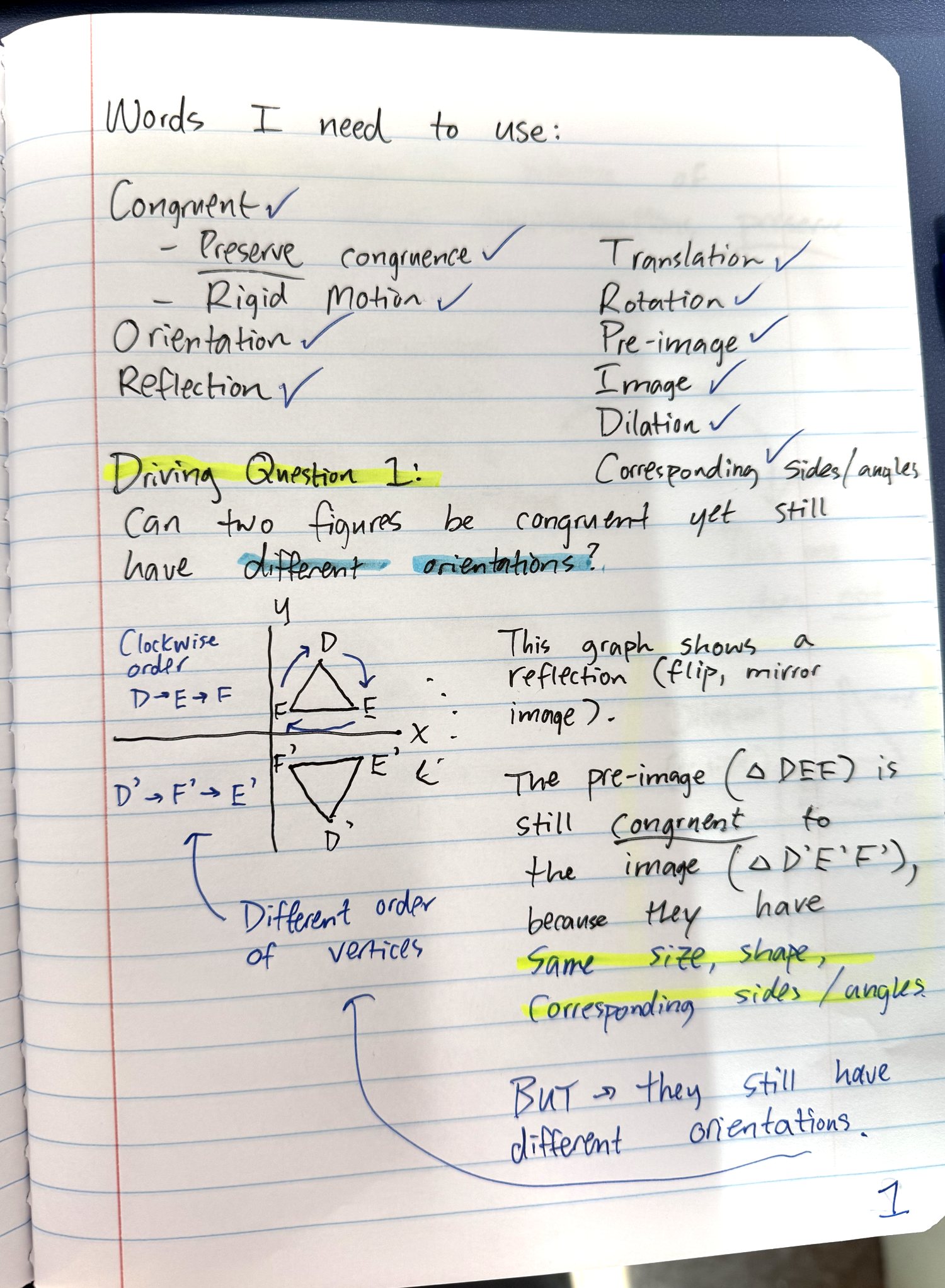
Naming a transformation from what it does to side lengths, angle measures, and orientation.
Both triangles have the same side lengths and the same angle measures. Read the vertices in order and the direction reverses.
1I can describe a transformation (rotation, reflection, translation) and its effect in terms of side lengths, angle measures, or figure orientation when given a graph of the pre-image. 8.10A
2I can identify a transformation when given the effects on a figure. 8.10A
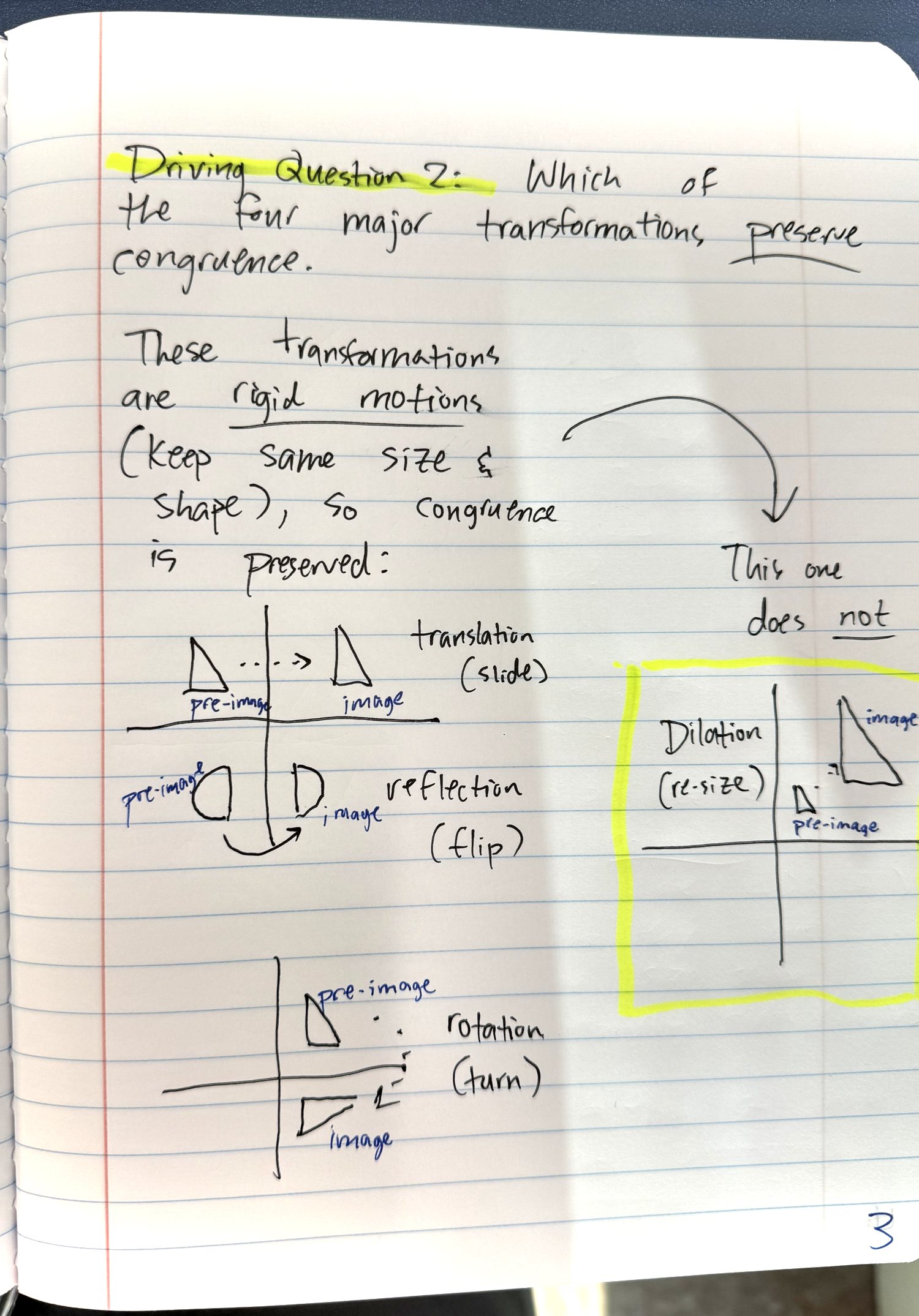
3I can describe a transformation that does or does not preserve congruence. 8.10B
Topic Overview Guide 1A, Check Your Understanding 1–11. Answers
Deck 01 ORIENTATION & CONGRUENCE — quiz-quiz-trade.
Translations
Sliding a figure without turning it or flipping it.
Every vertex moves the same distance in the same direction, so the rule is one pair of numbers added to x and to y.
6I can determine the algebraic representation of a translation when given the graph of the image and pre-image. 8.10C
- Translating points8.10A 8.10C
- Translating shapes8.10A 8.10C
- Determining translations8.10A 8.10C
- Translations: graph to algebraic rule8.10C
- Translations: description to algebraic rule8.10C
Topic Overview Guide 1A, Check Your Understanding 12–22. Answers
- Translations reviewarticle
- Translations introarticle
- Determining translationsarticle
- Topic Overview Guide 1A — Rigid MotionsPDF
Deck 02 TRANSLATIONS — quiz-quiz-trade.
Each vertex lands the same distance from the line of reflection, on the other side of it.
4I can identify whether an algebraic representation of a transformation preserves congruence. 8.10B
7I can determine the algebraic representation of a reflection when given the graph of the image and pre-image. 8.10C
- Reflecting points8.10A 8.10C
- Reflecting shapes8.10A 8.10C
- Determining reflections8.10A 8.10C
- Reflections: graph to algebraic rule8.10C
- Reflections: description to algebraic rule8.10C
- Rigid transformations: preserved properties8.10A 8.10B
Topic Overview Guide 1A, Check Your Understanding 23–35. Answers
Deck 03 REFLECTIONS — quiz-quiz-trade.
Rotations
Turning a figure about the origin without changing its size or shape.
The outlined image steps through 90° counterclockwise turns about the origin. One turn is (x, y) → (−y, x); each turn applies it again.
10I can identify a transformation as a translation or reflection when given the algebraic representation. 8.10C
8I can determine the algebraic representation of a clockwise and counterclockwise rotation about the origin when given a verbal description of the rotation. 8.10C
9I can determine the algebraic representation of a rotation about the origin when given the graph of the image and pre-image. 8.10C
Topic Overview Guide 1A, Check Your Understanding 36–48. Answers
- Rotations reviewarticle
- Rotations introarticle
- Determining rotationsarticle
- Topic Overview Guide 1A — Rigid MotionsPDF
Deck 04.1A ROTATIONS — quiz-quiz-trade.
Dilations and Similar Figures
Resizing a figure from the origin, and the ratios that stay fixed.
A dilation multiplies every distance from the center by the scale factor. Angle measures do not change, so the figures stay similar.
5I can identify the vertices of an image transformed in a way that does not preserve congruence, when given the vertices or graph of the pre-image. 8.10B
12I can determine the proportional relationship of corresponding sides of similar figures, where the figures have a common side, even with a rotated or reflected image. 8.3A
13I can write a statement about the relationship of the side lengths of a dilated image given the graph of the pre-image. 8.3B
- Dilations intro8.10A
- Dilating points8.3C 8.10A
- Dilations: scale factor8.3C 8.10A
- Dilating shapes: expanding8.3C 8.10A
- Dilating shapes: shrinking8.3C 8.10A
- Dilations and properties8.3B 8.10B 8.10D
- Equivalent ratios in similar shapes8.3A
- Finding equivalent ratios in similar triangles8.3A
- Finding equivalent ratios in similar quadrilaterals8.3A
Topic Overview Guide 1B, Check Your Understanding 1–12. Answers
Deck 05 DILATIONS & SIMILAR FIGURES — quiz-quiz-trade.
Algebraic Rules of Dilations
Writing a dilation as a rule on the coordinates.
The pre-image point, the image point and the origin sit on one ray. Dividing a coordinate of the image by the matching coordinate of the pre-image gives the scale factor.
14I can determine the algebraic representation of a dilation when given coordinates and graphs of the pre-image and image, including only being given a graph of the pre-image and the ordered pair of a corresponding point on the graph of the image. 8.3C
15I can identify the ordered pair on the graph of a dilation when given the scale factor as a variable. 8.3C
- Representing dilations algebraically, k greater than 18.3C 8.10A
- Representing dilations algebraically, k less than 18.3C 8.10A
- Dilations: scale factor8.3C 8.10A
- Dilating points8.3C 8.10A
Topic Overview Guide 1B, Check Your Understanding 13–24. Answers
Deck 06.1A ALGEBRAIC RULES OF DILATIONS — quiz-quiz-trade.
Area and Perimeter of Dilations
What a scale factor does to perimeter and what it does to area.
Perimeter is a length, so it scales by k. Area is two lengths multiplied, so it scales by k squared.
11I can determine the ratios of area and perimeter of the pre-image and dilated image, including through expressions. 8.10D
- Scale factors and area8.3B 8.10B 8.10D
- Scaling perimeter and area example 18.10D
- Scaling perimeter and area example 28.10D
- Solving a scale drawing word problem8.10D
- Dilations and properties8.3B 8.10B 8.10D
Topic Overview Guide 1B, Check Your Understanding 25–35. Answers
Deck 07.1 AREA & PERIMETER OF DILATIONS — quiz-quiz-trade.
Triangle Sum Theorem
The three interior angles of a triangle.
Whatever the triangle, the three interior angles add to 180°. Two known angles fix the third.
16I can complete a statement that describes an angle relationship when given a partially labeled diagram and three labeled diagrams of an angle relationship. 8.8D
17I can determine missing angle measures when given a partially labeled diagram. 8.8D
Topic Overview Guide 1C, Check Your Understanding 1–9. Answers
Deck 08 TRIANGLE SUM — quiz-quiz-trade.
Exterior Angle Theorem
The angle outside a triangle and the two interior angles it equals.
Extending a side makes a linear pair with the interior angle beside it. That is where the exterior angle relationship comes from.
16I can complete a statement that describes an angle relationship when given a partially labeled diagram and three labeled diagrams of an angle relationship. 8.8D
17I can determine missing angle measures when given a partially labeled diagram. 8.8D
Topic Overview Guide 1C, Check Your Understanding 10–18. Answers
Deck 09 EXTERIOR ANGLE — quiz-quiz-trade.
Parallel Lines and Transversals
The angles formed when a transversal crosses parallel lines.
Eight angles, two sizes. Which pairs are equal and which are supplementary depends on where they sit relative to the transversal and the parallel lines.
16I can complete a statement that describes an angle relationship when given a partially labeled diagram and three labeled diagrams of an angle relationship. 8.8D
17I can determine missing angle measures when given a partially labeled diagram. 8.8D
Topic Overview Guide 1C, Check Your Understanding 19–27. Answers
Deck 10.1 PARALLEL LINES & TRANSVERSALS — quiz-quiz-trade.
Slope and Similar Triangles
Why every slope triangle drawn on one line gives the same ratio.
Both right triangles share the line's angle with the horizontal and both have a right angle, so they are similar and their rise-to-run ratios are equal.
18I can complete a statement comparing the slopes of segments formed by points on the same line using similar right triangles shown on a coordinate plane and justify the comparison. 8.4A
19I can create a proportion comparing side lengths of segments to show that the slopes of segments formed by points on the same line are equal, given similar right triangles shown on a coordinate plane. 8.4A
20I can create a graph of a proportional relationship with a unit rate for which an equivalent rate must be calculated using the given fractional rate values. 8.4B
- Using similar triangles to reason about slope8.4A
- Similar triangles & slope: proportion of segments8.4A
- Similar triangles & slope: proportion using coordinates8.4A
- Graphing proportional relationships: unit rate8.4B
- Graphing proportional relationships from a table8.4B
- Relationship between slope and unit rate8.4B
Topic Overview Guide 1D, Check Your Understanding 1–9. Answers
Deck 11 SLOPE & SIMILAR TRIANGLES — quiz-quiz-trade.
Calculating Slope and Rate of Change
Finding a rate of change from a graph and from a table.
Slope is the change in y divided by the change in x. In a table the x-steps are not always equal, so use the actual differences.
21I can calculate a slope given a graph with an integral rate of change. 8.4C
22I can determine the rate of change given a table where the change in the independent variable is not constant. 8.4C
Topic Overview Guide 1D, Check Your Understanding 10–18. Answers
- Slope reviewarticle
- Slope formulaarticle
- Intro to slopearticle
- Topic Overview Guide 1D — Introduction to SlopePDF
Deck 12.1A CALCULATING SLOPE & RATE OF CHANGE — quiz-quiz-trade.
Slope and y-Intercept
Reading a rate and a starting value off a real-world line.
The y-intercept is the value when x is zero — the base amount. The slope is what is added for every one unit of x.
23I can determine slope and y-intercept given a graph or table of a real-world linear function, and explain its meaning. 8.4C
Topic Overview Guide 1D, Check Your Understanding 19–27. Answers
Deck 13.1A SLOPE & Y-INTERCEPT — quiz-quiz-trade.
Proportional and Nonproportional Relationships
Two kinds of straight line: through the origin, and not.
The orange line passes through the origin: y = 1.5x, proportional. The dashed line starts at (0, 3): y = 1.5x + 3, nonproportional.
I can identify a table, graph, and equation representing a proportional relationship given a verbal description including the unit rate of change. 8.5A
I can complete a table representing a proportional relationship given corresponding x-values and y-values or a verbal description. 8.5A
I can create a graph representing a proportional relationship given corresponding x-values and y-values or a verbal description. 8.5A
I can write an equation in the form y = kx that represents a proportional relationship and identify the constant of proportionality, given a table, graph, or verbal description. 8.5A
I can complete a table or graph that represents a linear non-proportional relationship given a verbal description, including from fractional rates of change and initial values. 8.5B
I can distinguish a table, graph, or equation as proportional or nonproportional and justify using attributes of proportional and nonproportional relationships. 8.5F, 8.5H
I can solve for the independent and dependent variables given mathematical relationships involving direct variation, including completing a table to model. 8.5E
- Proportional versus non-proportional situations8.5F 8.5H
- Graphs of proportional relationships8.5A
- Graphing proportional relationships from a table8.5A
- Equations of proportional relationships8.5A
- Relationship between slope and unit rate8.5A
- Solving problems with direct variation8.5E
- Proportional & non-proportional functions8.5F 8.5H
- Identify proportional relationships
- Identify proportional relationships from graphs
- Graphing proportional relationships
- Write y = mx proportional equations
- Writing proportional equations from tables
- Relate unit rate and slope
- Proportion word problems
- Identify proportional & non-proportional functions
Unit 2 Overview Guide, Check Your Understanding 1–23. Answers
Lessons 2.01–2.05.
Writing Linear Equations
Rate of change and initial value, read from any representation, written as y = mx + b.
The line crosses the y-axis at (0, 1), so b = 1. From any point on the line, over 1 and up 2, so m = 2. The equation is y = 2x + 1.
I can identify an equation in the form y = mx + b that models a real-world situation, given the rate of change, graph, table, or initial value. 8.5I
I can identify an equation in the form y = mx + b that models a real-world situation, given a set of independent and dependent values. 8.5I
I can write an equation in the form y = mx + b that models a linear relationship, given a real-world or mathematical context. 8.5I
Unit 2 Overview Guide, Check Your Understanding 24–38. Answers
Lessons 2.05–2.08.
Identifying Functions
Every input, exactly one output.
The vertical line test. The line sweeps across the graph and never touches two points at once, so every input has exactly one output. The relation is a function.
I can identify a relation as a function from a combination of representations (graphs, tables, ordered pair sets, mappings), justifying the decision using attributes of functions. 8.5G
I can determine which point could be added to a relation so that the relation remains a function. 8.5G
Unit 2 Overview Guide, Check Your Understanding 39–50. Answers
Lessons 2.09–2.10.
Points of Intersection
Where two lines cross, one ordered pair satisfies both equations.
y = x + 2 and y = −0.5x + 8 cross at (4, 6). Substitute: 4 + 2 = 6 and −0.5(4) + 8 = 6. The ordered pair satisfies both equations.
I can determine the point of intersection of two linear equations and write the coordinates of the ordered pair given a graph or equations in the form y = mx + b. 8.9A
I can describe each coordinate of the ordered pair at the point of intersection representing a real-world situation given a graph. 8.9A
I can verify that an ordered pair is the solution to two linear equations by substituting its coordinates into both equations. 8.9A
Unit 2 Overview Guide, Check Your Understanding 51–60. Answers
Lessons 2.11.
Scatterplots and Association
Two measurements per point; the cloud shows the pattern.
Each point is one pair of measurements. As x increases, y tends to increase: a positive linear association.
I can identify and construct a scatterplot that shows the relationship of a bivariate set of data such as linear, non-linear, and no association. 8.11A
I can determine a set of points that could be added to the graph of a bivariate set of data so that the relationship remains linear. 8.5C
I can describe the relationship of a bivariate set of data graphed on the coordinate grid as linear or non-linear. 8.5C
- Introduction to scatter plots8.11A
- Interpreting scatter plots8.11A 8.5C
- Scatter plot: smokers8.5C
Unit 3 Overview Guide, Check Your Understanding 1–14. Answers
Lessons 2.12–3.01.
Trend Lines and Predictions
A line through the cloud, used to estimate what was not measured.
A trend line follows the cloud, not the points. Read up from x = 5.5 to the line, then across: the line predicts y ≈ 5.
I can construct a trend line through a scatterplot and use it to predict the value of either variable when given the value of the other, for a bivariate set of data with a positive or negative linear association. 8.5D
Unit 3 Overview Guide, Check Your Understanding 15–25. Answers
Lessons 3.01–3.03.

Student Resources

Calendar
How the week works
Quarter windows
| Quarter | Window | New learning |
|---|---|---|
| Quarter 1 | Aug 11 – Oct 7 | Unit 1 |
| Quarter 2 | Oct 13 – Dec 18 | Units 2–3 |
| Quarter 3 | Jan 6 – Mar 5 | Units 4–5, start of Unit 6 |
| Quarter 4 | Mar 8 – May 21 | State assessment review, then Unit 8 |
Assessment dates
| Assessment | When |
|---|---|
| Standards Mastery Check 1 | Tuesday, October 6 |
| Standards Mastery Check 2 | Tue–Wed, Dec 8–9 |
| Standards Mastery Check 3 | Wednesday, February 24 |
| State Assessment Snapshot Exam 1 | Week of March 22 |
| State Assessment Snapshot Exam 2 | Week of April 5 |
| Mathematics STAAR | Wednesday, April 21 |
Planned dates can shift slightly. Any change posts here and in the Family Guide. Out of fairness to families, the progression of assignments does not change.
Revision due dates are printed with each assignment and in the Family Guide, weeks 1–37.
Full-year calendar
Every graded assignment, week by week, all four quarters — to read through or plan ahead. Planned dates can shift slightly; the progression does not change.
Open the full-year calendar
Every quarter is 50 points
Three categories, weighted by the district. The bar below is drawn to scale.
Every assignment and grade is mapped out in the Family Guide.
Performance Tasks
Multi-problem tasks completed independently in class, 30–40 minutes. Scored 1–4: Beginning, Developing, Proficient, Exemplary. The score is writing and explanation based; a 4 is earned through thorough explanation.
Most graded work can be revised, objective by objective, with a reflection attached, within one week of return. A revised 4 becomes permanent after a Last Step slip — a short in-class demonstration that the objective now stands on its own. Only very few assessments (Standards Mastery Checks and Snapshot Exams) are not revised.
Graded on the process standards
Every three weeks each student turns in one exhibit of their own mathematical work and writes a short explanation of which process standard it shows. The standards are TEKS 8.1(A) through 8.1(G), written by the Texas Education Agency. Work done alone and work done with a team can both earn full credit. Sharing ideas will always be rewarded for generating new ideas.
| Group | Standards | What it takes |
|---|---|---|
| Tools to Know | 8.1A · 8.1B · 8.1C | Claimable with work done on your own. |
| Ways to Show | 8.1D · 8.1E · 8.1F · 8.1G | Need someone on the other end: a teammate, the class, or a reader who used the work. |
Scored 1, 0.5, or 0. A 0.5 comes back with one reason and can be fixed for full credit. The only way to score a 0 is to turn in nothing.
Three grades per quarter, one every three weeks.
End most class periods. Never scored individually; they count as evidence toward the Mathematical Process grade.
Never graded. A completed guide turned in at quarter's end raises that quarter's Standards Mastery Check score by 5% per guide. Only that quarter's guides count.
Two checks each quarter: mid-quarter and end-of-quarter.

Family Resources
Mr. Linam

Originally from Fort Smith, Arkansas, Mr. Linam is proud to join the Longfellow team. He holds a Bachelor of Arts in Political Science from Washington University in St. Louis and a Master of Science in Education from Johns Hopkins University. In 2024 Mr. Linam received the Middle School and District Teacher of the Year award at Tulsa Honor Academy. He most recently taught at Greiner Exploratory Arts Academy in Dallas. A trained grassroots organizer and Teach for America alum, he sees education as one of the best and most powerful ways to make a difference.
Outside the classroom Mr. Linam enjoys running outdoors, reading historical and educational literature, and spending time in the park with his partner and dog. Entering his fifth year in mathematics education, he is excited to help students establish serious academic goals and cheer on every success.

klinam@dallasisd.org — email is answered within one school day.